
Family therapy and couples therapy
I am a family therapist in Tallinn working with families, couples and individuals in Estonian and English.
Family therapy is a place where people can speak safely about what is really happening in their relationships — and find new ways of understanding one another. The focus is on relationships, their dynamics, and the patterns that often develop quietly over time, yet shape everyday life very strongly.
Why come to therapy together?
Every person belongs to some kind of human system, and first and foremost that is the family. Close relationships can offer safety, support and comfort, both in good times and in periods of stress, difficulty, sadness or uncertainty. In difficult moments especially, we long to feel the steady presence, encouragement and understanding of those closest to us. And yet these same relationships are often where misunderstandings, disappointment and repeating conflict arise most easily.
Family therapy looks at the family as a system: when one person changes, the whole system shifts, and the system in turn affects each individual within it. Therapy offers a safe space to listen and be heard, to understand and be understood, and to find new ways forward together, so that relationships can become more supportive and life as a whole more livable.
When is family therapy worth considering?
If conversations keep circling back to the same place — or stop altogether — it can be hard to move forward on your own. If it feels difficult to put your needs or worries into words, if one partner feels misunderstood, or if trying to understand the other seems almost impossible, it may be time to involve a family therapist. Avoided conversations tend to create hidden problems, and over time these often grow larger. Therapy makes it possible to have the conversations that may feel too uncomfortable to have at home, in a calmer and safer setting.
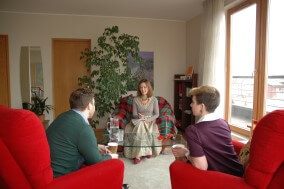
Major life changes — moving to a new place, the birth of a child, adolescence, a child leaving for university, separation, or bereavement — often place extra strain on family life. Blended families, which are increasingly common today, can be especially complex, because people often enter them carrying expectations shaped by a more traditional idea of how family life should work. Here too, therapy can offer experienced guidance.
Therapy can also be helpful when adult children struggle to maintain a relationship with their parents, or when unresolved pain from childhood continues to shape life in the present.
What can you expect?
Therapy does not mean that every problem disappears. What can change, however, is the way people deal with those problems. The more motivated and open the people involved are, the more likely it is that meaningful change can happen.
Family therapy may lead, for example, to stronger emotional connection between partners or family members, greater mutual understanding, improved coping in daily life, and the restoration of lost contact. In this way, a couple or a family can move on from stalemate or power struggles towards a more satisfying relationship, with greater commitment to one another and to the family as a whole.
When the emotional bond between partners has weakened, when care for one another has faded, when their needs feel hopelessly different, or when at least one partner has lost the wish to continue living together, couples therapy can also help people separate more thoughtfully. A neutral perspective is especially valuable when children are involved.
Therapy is not about finding someone to blame. It is about looking at what is really happening in the relationship — how people affect one another, what patterns have formed, and what each person needs. Needs matter greatly in family therapy: for some, it is difficult to express them clearly and calmly; for others, it is difficult to recognise or respond to the needs of those closest to them.
What is the difference between couples therapy and family therapy?
Without becoming too theoretical: family therapy and couples therapy are built on the same principle — the relationship is understood as a whole. Family therapy looks at the wider family as a system of relationships, while couples therapy focuses on the relationship between two partners.